Opinion
Mining majors will pilot anything. Good luck getting it adopted.
Majors are the most common first customer for mining startups, usually as a pilot. Data on 128 startup technologies, and what founders should do next.
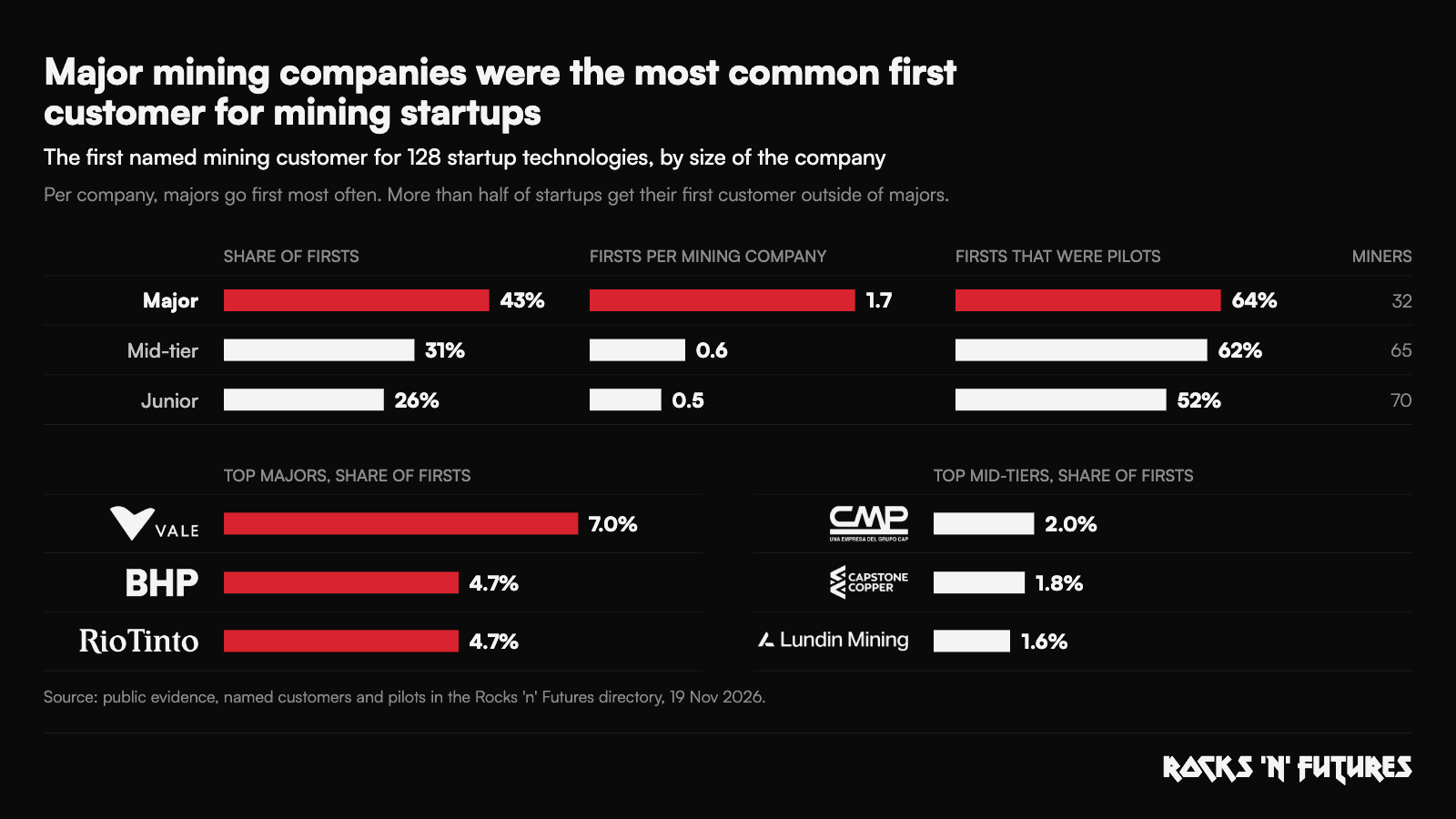
Mining is the industry where everyone wants to be first to be second, so one big name on the slide should bring the rest of the market with it. Founders believe this enough to wait a year for a trial, pay for much of it themselves and put the logo on the first page of the investor deck. We couldn’t find any data showing which companies are the best fit for a pilot and which ones are brave enough "to be first to be first".
So we counted. The Rocks 'n' Futures directory records which miner went first for 128 selected startup technologies, and whether a second miner came after.
Majors do go first most often: they were the first named miner for 43% of the startups, ahead of mid-tiers (31%) and juniors (26%). Company for company, a major goes first about three times as often as a mid-tier.
When a major miner adopted a technology first, a second miner bought it in 27% of cases. That figure was 38% when the first customer was a mid-tier miner and 42% when it was a junior. Founders often chase big names for credibility, but these figures suggest that smaller customers may be better at encouraging others to buy.
The trial is nearly free for the major, and the startup pays for it
A big miner can afford to be curious. In April 2024 Rio Tinto committed A$14.4m over three years to an accelerator it runs with Founders Factory, a venture builder, for startups at the earliest stage. In 18 months the pair sifted more than 1,500 startups and backed 18. BHP's venture arm has put money into 13 of the vendors in the directory. Vale belongs to Mining Hub, a Brazilian club of 24 miners that pairs its members with startups.
For firms like these the pilot is the product. An innovation team exists to find technology and try it, and a trial costs little beside a fleet of haul trucks. The majors in the directory have each taken on 3.3 startup technologies on average, and four in ten have taken three or more. Among mid-tiers 76% have taken exactly one. Among juniors the share is 94%.
The final bill gets to be paid elsewhere. Expande, a programme of Fundación Chile, surveyed 180 mining-technology firms this year. More than half needed over 12 months to get from concept to a first pilot at a mine. Some 78% called that pilot a success, yet only 38% recovered what it cost them. To the miner a pilot is an option, cheap to buy and free to let lapse. To the startup it is the runway.
What percentage of mining technology pilots progress to commercial rollout?
What happens next is mostly nothing. The directory holds 60 pilots that startups have run at majors. It records 29 as completed with no sequel and 19 with an outcome nobody has published. Not one shows a conversion to a commercial contract. Mining Hub's own intel points the same way: its members have run 90 proofs of concept and signed 20 contracts. Bain, a consultancy, reckoned in 2020 that only a quarter of energy and natural-resources firms got their digital projects beyond the pilot.
Three things explain the stall.
The first is who decides. An innovation team picks the startup and runs the trial. A site manager and a procurement office must then buy the thing, and neither asked for it. In the Expande survey only 44% of startups had a sponsor inside the mine, and 51% found the miner's procurement unfit for new technology. Startups blamed stalled pilots most often on the client's shifting priorities (65%).
The second is size. A giant runs the same systems across dozens of sites, so a yes to one startup becomes a decision for all of them. The technology must also work at a scale no trial reproduces. Bruno Arcadier, head of Vale Ventures, says the hard part is carrying a startup from the lab through pilots to a plant that handles a million tonnes and still makes money.
The third explains why other miners stay away. Being first to be second requires knowing how the first one fared, and majors seldom say. A trial at a firm that tries everything tells a rival little about whether anyone needs the thing.
In a 2025 survey of exploration professionals that we did together with VRIFY, 60% named a peer's success story as the most persuasive proof. A logo on a slide is no such story.
Are mid-tier mining companies a good fit for a pilot?
Mid-tier miners have no department paid to be curious. Technology gets in when one site has one problem and somebody with a budget wants it gone. A front-line manager can approve about $150,000 without help. That is enough for a first deployment and too little to hide in a head-office innovation fund.
When an operator that watches every dollar pays to fix a problem, competitors take notice. It tells them the problem matters enough to justify the cost. Capstone Copper, a mid-tier with mines in Chile and Arizona, was the first named miner for NextOre, which makes ore-sorting sensors, in 2019 and for Jetti Resources, a copper-leaching firm, in 2020. Both startups went on to win other miners. Freeport-McMoRan, an American giant, followed Capstone to Jetti within three years.
The catch here is capacity. Three in four mid-tiers in the directory have taken on a single startup. A survey of buying teams at the 150 biggest miners by Harbour found that they prefer incumbents, shortlist three vendors and remember failures: 68% said a past project gone wrong added most to their doubts. A mid-tier offers just one slot, and it stays occupied.
Are junior mining companies a good fit for a pilot?
Juniors behave differently. Half of their deals with startups in the directory (48 of 95) concern exploration and targeting, which they buy as a service for one project at a time. The contracts are short and the decision belongs to a handful of people. Sometimes the vendor pays: in 16 cases the startup took a stake in the project or a royalty in place of a fee.
Almost every junior has tried exactly one startup. Yet a survey that works on one junior's ground sells readily to the next, which is how Fleet Space got from Talon Metals to 13 mines. The market is wide, shallow and short of cash. It suits firms that sell exploration and almost nobody else.
What to do about it as a mining tech startup?
A pilot at a major is worth taking for what it is: research with a famous witness. Our advice to a startup is to settle four things before the first sensor goes in.
- Learn who signs the purchase order if the trial works, and get that person to agree to the test.
- Write down the number that counts as success and the date the trial ends.
- Charge for it, since most of the Chilean startups never got their money back.
- And secure the right to publish the result with the miner's name on it as a press release.
That clause is more important than the fee, as it is the only part of a pilot a "first to be second" customer can use. While the trial runs, sell to a mid-tier with the same problem.
A scale-up that wants a commercial rollout needs a different plan, and more pilots will not supply it. A rollout is a procurement event, so the firm needs a contract to sell under. It can negotiate its own framework agreement or ride on a supplier that already holds one. RPMGlobal, a mining-software firm that Caterpillar now owns, held twelve with global miners last year.
The scale-up should then pick one commodity in one region and win three or four mid-tier sites where the general manager can sign. It should make those managers easy to phone.
Among Australian mining businesses that innovate, only 18.7% take ideas from others in their industry, against 30.1% of firms in general, so references rarely travel unaided. With the neighbours' numbers in hand, it can approach a major through one of its sites, where the problem lives, and leave the innovation team for later.
Should the giants start publishing what their pilots find, their logos will be worth what founders pay for them. Until then, a smaller name opens more doors.
How we counted
The figures come from the Pilots & Deployments records in the Rocks 'n' Futures directory, read on 19 November 2026. We kept records with a named miner, stated evidence and a date: 263 records covering 128 startup technologies and 167 mining companies. The first miner is the one with the earliest date, and miners in the same year share the credit when a date gives only the year. We left out established vendors such as Caterpillar and Sandvik, because their earliest record is rarely their first customer. The size labels are Rocks 'n' Futures' own. The numbers are based on public evidence, such as website announcements or press releases.
Sources
- Rocks 'n' Futures directory, own data, November 2026
- The Next Web, 10 October 2024, on Rio Tinto's A$14.4m commitment
- Australian Mining, undated, on 1,500 startups reviewed and 18 backed
- Vale, technology page, read 20 November 2026, on Mining Hub's 90 proofs of concept and 20 contracts (the page gives no date for the tally)
- Bain & Company, 13 August 2020
- Global Corporate Venturing, 28 August 2024, interview with Bruno Arcadier
- Expande survey via El Ecosistema Startup, 30 September 2026 (press coverage; full report not read)
- Harbour survey via International Mining, 27 June 2025, 75 respondents
- Miles Galli, Substack, undated, one practitioner's view
- RPMGlobal FY2025 investor presentation, 26 August 2025
- Australian Bureau of Statistics, Characteristics of Australian Business 2024-25, released 25 June 2026
- The 2025 Mineral Exploration Tech Report, VRIFY, survey of 135 exploration professionals designed with Ipsos and Marina Baslina, August 2025