Report
LinkedIn Advertising in Mining: The 2026 Report
Should vendors advertise? What 38,000 ads say about where mining's marketing money goes, what the industry now wants to hear and the problems almost nobody is advertising answers to.
The full report
Download the full report (PDF, 21 slides)
Leave your email to download the PDF. Your name and company are optional.
The typical company advertising to mining on LinkedIn spends about $3,600 a year, and a third of this year's advertisers ran a single ad, which, if you sell anything to miners, is far better news than it sounds.
Since 2025, stronger gold and copper markets have put talk of another mining supercycle back on the table, and the question for every business serving this industry is how to be in position when the next wave of spending arrives.
In 2024 I tried to answer a narrower version of that question in the LinkedIn Advertising in Mining Report 2024, analysing thousands of LinkedIn ads to work out whether the platform deserved a place in a mining supplier's marketing budget at all.
The mood back then was defensive, and in most of my conversations the enthusiasm came with tight budgets and nobody willing to say when spending would recover.
Two years later, I wanted to see whether the change in mood had shown up where it counts, in what companies are prepared to pay for.
I've long thought LinkedIn is one of mining's most overlooked advertising channels, which makes it a good place to look for room that nobody has claimed yet.
So this time we collected 95,459 ads from LinkedIn's Ad Library search results for "mining", covering 19 October 2025 to 18 October 2026, cleaned out everything that didn't belong, and ended up with more than 38,000 company ads from roughly 3,500 advertisers across mining and its supply chain, which we compared with our 2024 collection.
Personally, I find ads more honest than most trend reports, because every campaign puts real money behind a commercial assumption about what will make a buyer act.
Across thousands of campaigns, those bets show who dominates the conversation, which messages are crowded, where the gaps sit and what suppliers believe their customers will respond to.
To be clear, spend shows belief rather than results, and nothing in the Ad Library tells you which of these campaigns actually won business.
But if you're deciding whether to advertise on LinkedIn, where to focus and what to say so someone actually notices you, knowing what everyone else is betting on is a pretty good place to start.
At a glance
Equipment makers (23% of ads) and technology vendors (17%) produce four in ten mining ads between them.
A few advertisers spend heavily and most commit very little, with the top 10% accounting for almost 80% of estimated spend, the median advertiser spending about $3,600 a year, and only 23% of the advertisers we saw in 2024 coming back in 2026.
The pitch has moved to money, with sustainability and ESG falling from 23% of ads to 16% while capital and investment rose from 11% to 15%, and productivity and cost still the biggest theme, in almost three ads in ten.
Equipment suppliers are selling more life out of the machines miners already own, with service, spare parts and rebuilds in 32% of their ads, up from 24%, and automation and autonomy more than doubling to 12%.
AI mentions almost doubled to 5% of ads, but they sit in 17% of software ads against just 1% of equipment ads, and the trend looks far bigger than it is if you let a few prolific advertisers count.
The industry is paying to make its own case, with advocacy rising from 21% to 41% of association ads as advertisers chase investment, public support and confidence in mining itself.
And some of the most consequential problems in mining, namely tailings, permitting, mine closure and cybersecurity, each turn up in fewer than 2% of ads.
Who advertises on LinkedIn?
Equipment makers and technology vendors still run four in ten mining ads, but the parts of the field that grew are the ones that speak for the industry rather than sell to it.
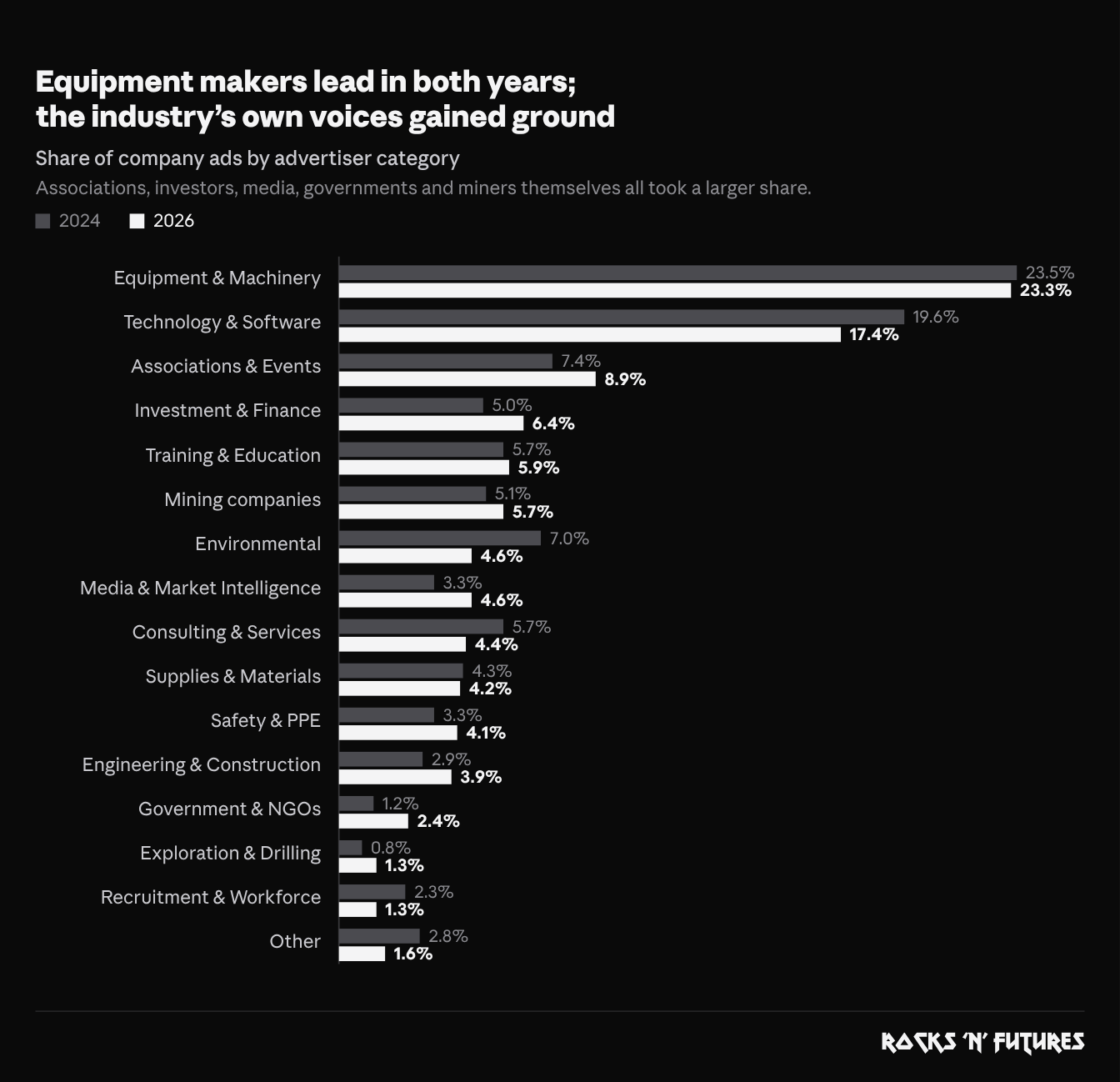
Equipment makers hold the largest share in both years at 23%, and technology vendors follow at 17%, slightly below their 2024 share.
The growth came from associations and events (7.4% to 8.9%), investment and finance (5.0% to 6.4%), media and market intelligence (3.3% to 4.6%), government and NGOs (1.2% to 2.4%) and mining companies themselves (5.1% to 5.7%).
Environmental specialists (7.0% to 4.6%) and consultants (5.7% to 4.4%) lost the most ground.
So if you're a supplier, your ad now competes for the same scroll as advocacy campaigns, investor pitches and conference promotions.
LinkedIn's mining feed is less of a shop window than it was, and any campaign plan should start from that.
What is the average spend per mining advertiser on LinkedIn?
The typical mining advertiser spends about $3,600 a year on LinkedIn, which is roughly what plenty of suppliers spend sending one person to a single conference.
The average is about $35,000, ten times higher, because a few heavy spenders drag it up in every category, and that's exactly why the average is the wrong number to plan around.
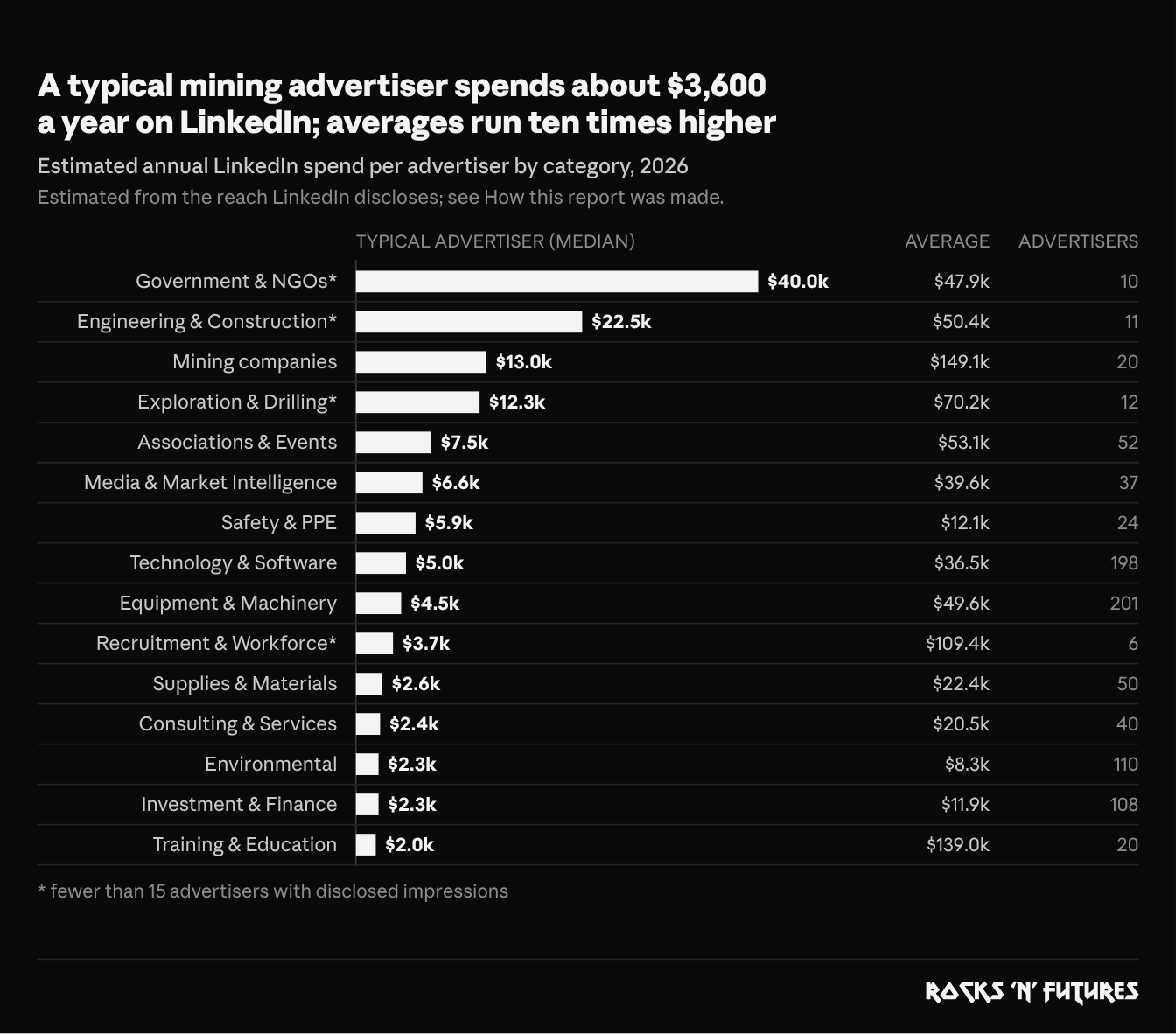
Government and NGO campaigns, engineering firms, mining companies and exploration firms show the highest typical budgets, while training providers, investor promoters, environmental firms and consultants spend the least.
A quarter of advertisers spend less than $720 a year, and the top tenth account for almost four-fifths of estimated spend.
In total, mining ads with visible reach drew an estimated $15.8M in 2026, led by equipment makers ($3.6M), technology vendors ($3.5M) and training providers ($2.2M).
For perspective, about $17,000 a year would put you in the top quarter of mining advertisers by estimated spend, and $66,000 would put you in the top tenth.
The bar to stand out is low.
And there aren't many marketing channels left in mining where you can still say that.
Who dominated the LinkedIn advertising field in mining in 2026?
A handful of names dominate the feed, and the biggest of them isn't selling equipment or software at all.
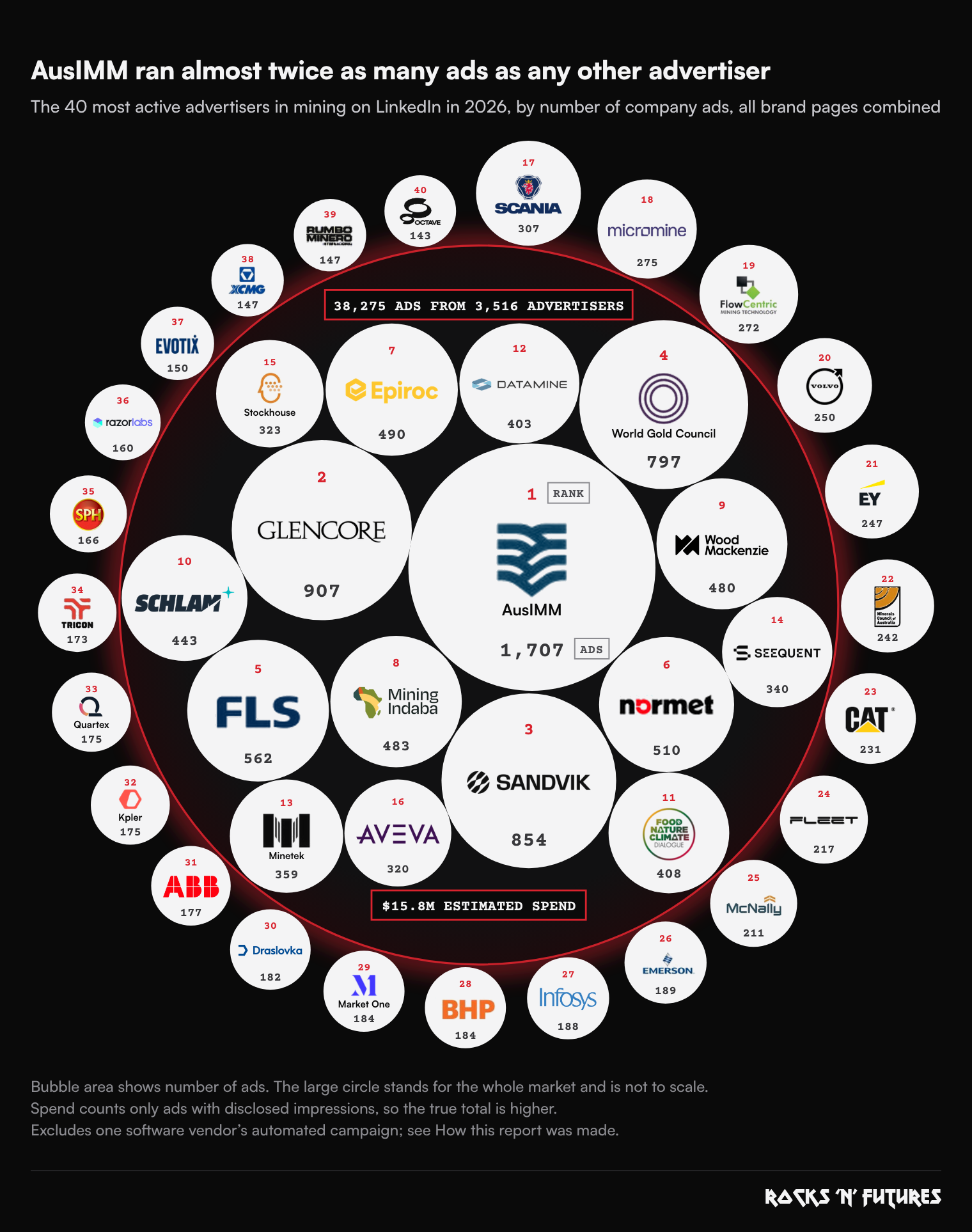
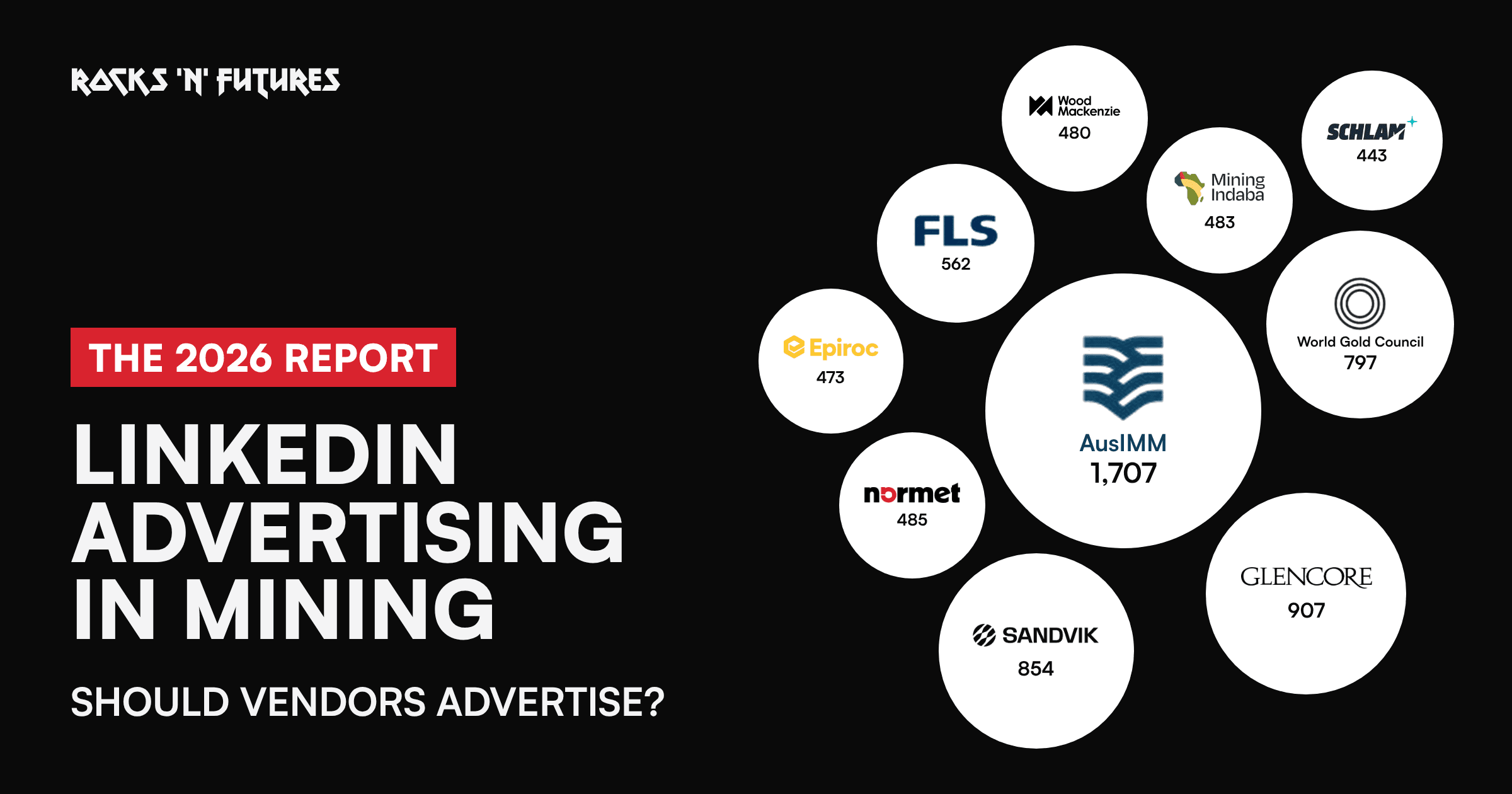
The Australasian Institute of Mining and Metallurgy (AusIMM) ran 1,707 ads for courses and certificates, almost double its 2024 count and almost twice as many as the next advertiser.
Glencore ran 907 across its pages, and its Australian arm alone went from 29 ads to 594, making the case for coal and metals under the line "Advancing everyday life".
The World Gold Council ran 797, up from 306, for a brand series aimed at investors and the public, in a year when gold traded above $4,000 an ounce.
Technology vendors take 11 of the top 40 places and equipment makers 10, and the other 19 are a mix of associations and events, publishers, miners, investor promoters, engineering firms, specialist suppliers and a campaign group.
But the more telling number is how few advertisers stick around.
A third of this year's advertisers ran a single ad, and only 23% of the advertisers we saw in 2024 advertised again in 2026.
Commitment predicts staying power, with 81% of those that ran 50 or more ads in 2024 coming back, against 11% of those that ran one.
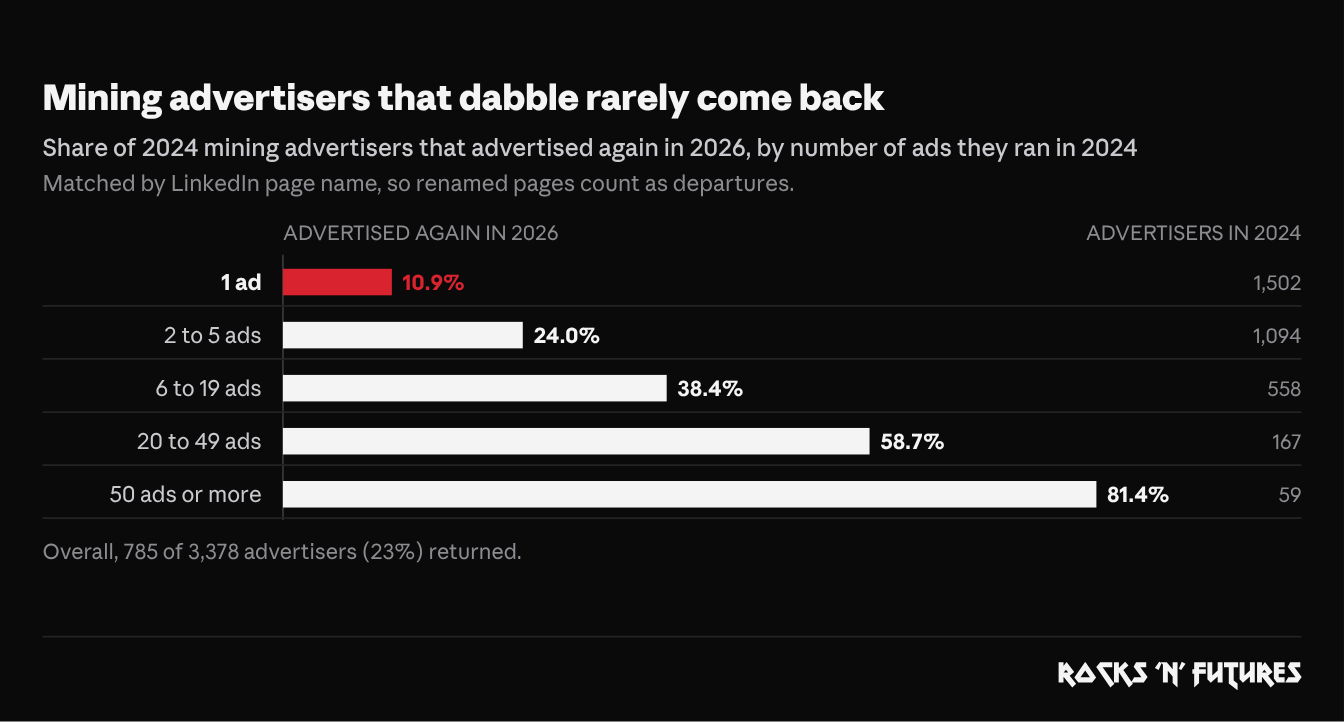
Anyone who has sold into mining knows the industry buys slowly and from suppliers it already knows, so an ad that runs once reaches almost none of next year's buyers.
Running one ad and stopping is a bit like turning up to one industry drinks, leaving early and wondering why nobody calls.
The advertisers who come back year after year are the ones building familiarity before the tender arrives.
What changed in LinkedIn mining advertising since 2024
The language of mining advertising has moved from the planet to the balance sheet, and the speed of the shift says a lot about who suppliers are really listening to.
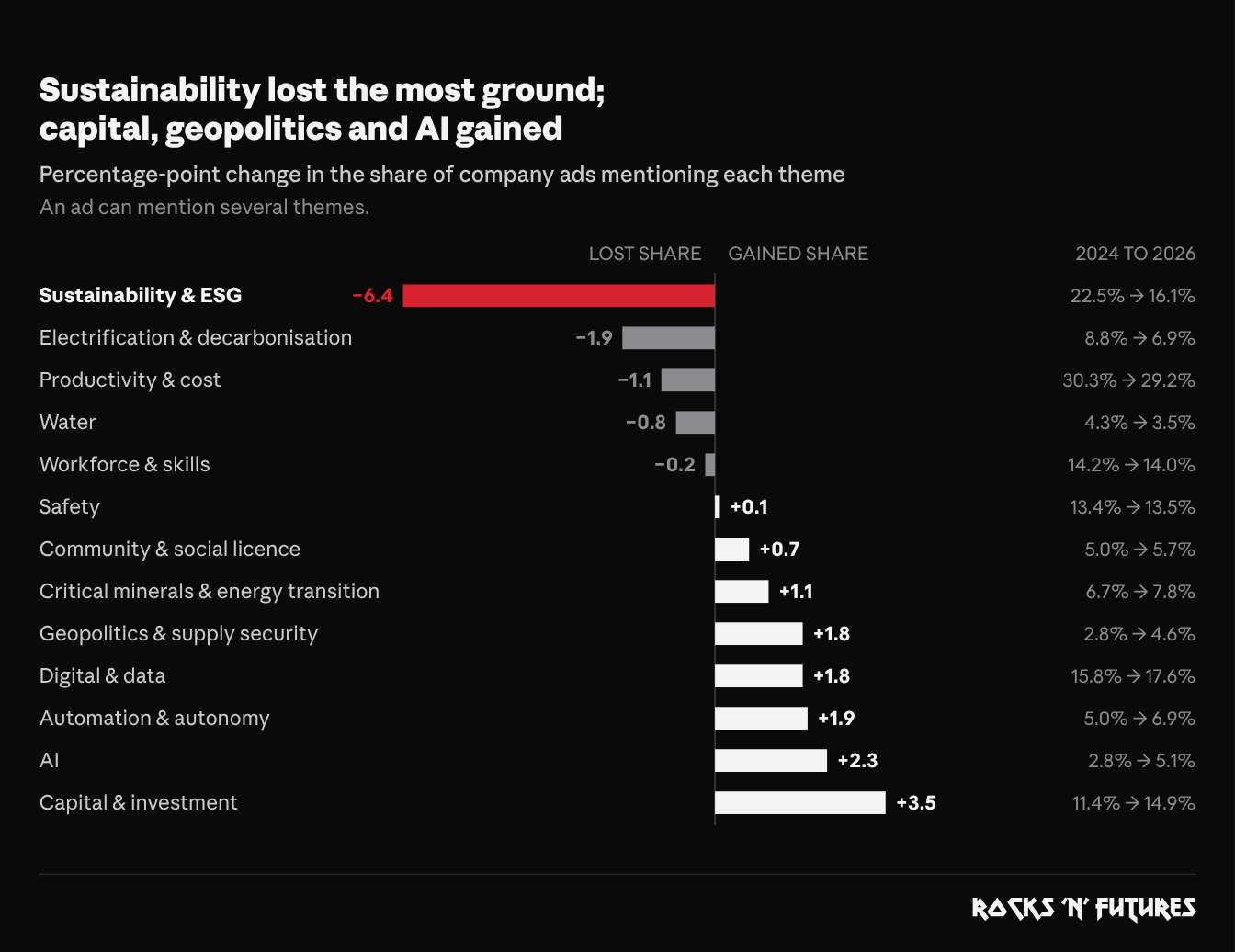
Sustainability and ESG lost the most ground, falling from 23% of ads to 16%, and talk of electrification and decarbonisation fell from 9% to 7%.
Meanwhile capital and investment rose from 11% to 15%, geopolitics and supply security from 3% to 5%, and critical minerals from 7% to 8%, while productivity and cost remain the biggest theme of all, in almost three ads in ten.
None of this happened in a vacuum.
Rio Tinto cut the decarbonisation spending it plans to 2030 from as much as $6bn to between $1bn and $2bn, BHP shelved or deferred renewable-energy and lower-emissions projects at its iron-ore operations, and the European Union narrowed its sustainability-reporting rules, all while gold traded above $4,000 an ounce and governments raced to secure supplies of critical minerals.
Suppliers follow their customers' budgets.
And those budgets moved.
Don't get me wrong, sustainability still matters to plenty of buyers.
But a supplier still leading with it is speaking a language its buyers have pushed down the list, and the same product framed around cost, uptime, capital efficiency or security of supply matches where decisions are being made now.
AI influence on LinkedIn advertising in mining
Artificial intelligence is the one fashionable theme still rising, and it's concentrated in the corners of the industry that have something to sell about it.
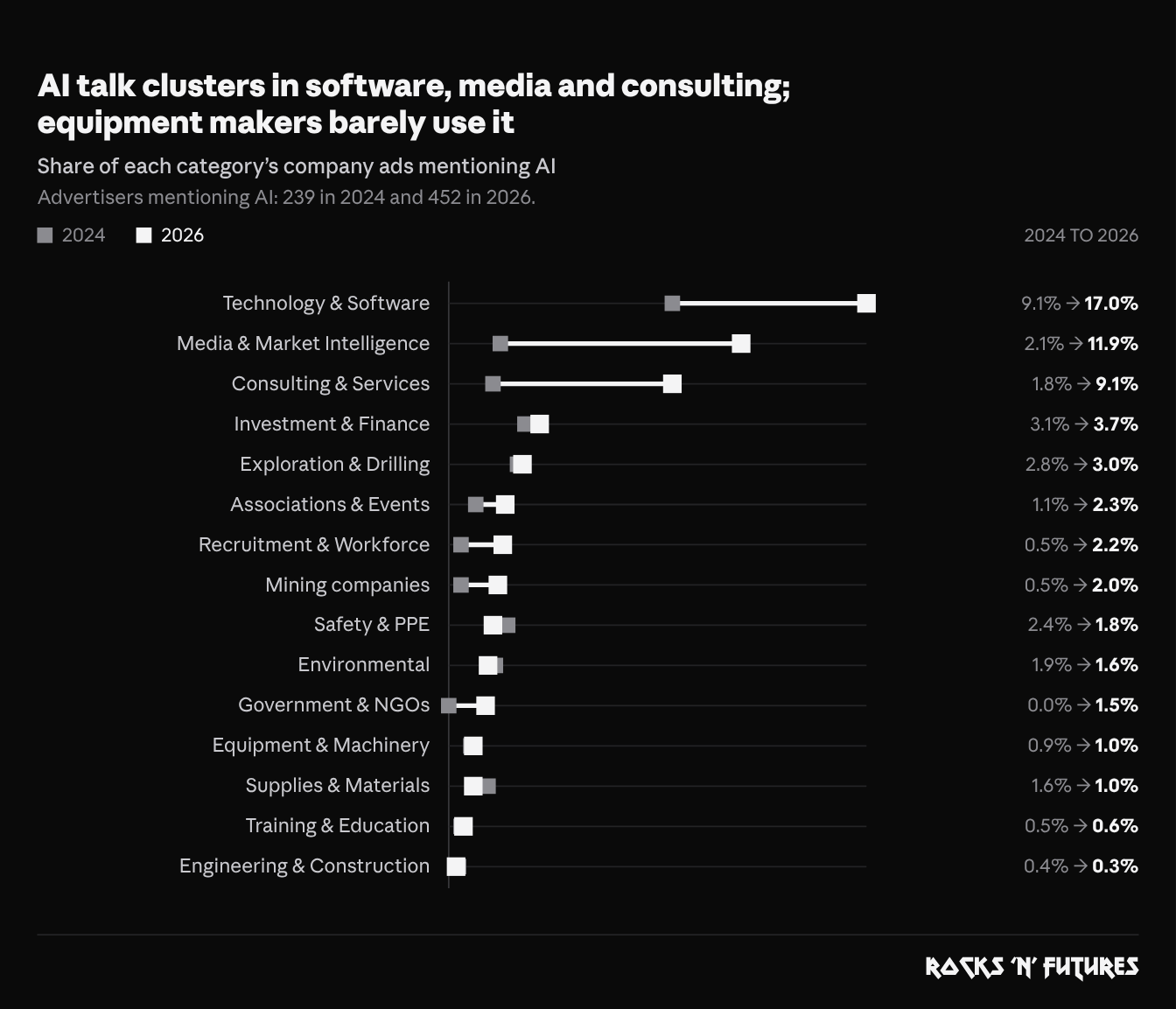
The share of ads mentioning AI almost doubled to 5%, and the number of advertisers using the term nearly doubled too, from 239 to 452.
The talk clusters among software vendors (17% of their ads), publishers and market-intelligence firms (12%) and consultants (9%).
It's hard to ignore the irony that equipment makers, whose machines produce much of the data AI would learn from, mention it in 1% of their ads, exactly as they did in 2024.
And then there's C3 AI, an American software company, which ran an automated campaign of 18,432 near-identical ads, enough to make AI appear in a third of all mining ads if you counted it in, which is why this report leaves it out.
For the record, that one campaign says more about what automation does to ad volume than about mining's appetite for AI.
As I read it, the AI conversation in mining belongs to companies selling software and advice, while the companies that build the machines have barely joined it.
So software vendors now compete with a crowded message, and equipment makers are leaving the AI story to others, which is either sensible restraint or a gap somebody else will fill.
Signs of a maturing market
Alongside the change in message, mining advertisers have also become more deliberate, and the signs are fairly consistent.
Fewer of them are one-off advertisers, with the share running a single ad falling from 44% to 34%, and the typical advertiser now runs three ads a year instead of two.
They're clearer about what they want, with ads carrying no call-to-action button falling from 43% to 33%.
They're trying more formats, with single-image ads falling from 69% to 61% of the total as carousels, documents, article ads and executives' promoted posts gained ground.
Nearly twice as many advertisers mention AI as in 2024.
More of the industry is speaking for itself, with the number of mining companies advertising rising from 96 to 130 and exploration-technology firms from 21 to 28.
And ads with Spanish, French or Portuguese buttons rose from 1.0% to 1.6%, which is still small but makes sense for an industry with large operations in Latin America and French-speaking Africa.
Category performance in 2026
Each part of the industry tells a different story about what it thinks buyers want, and four categories carry most of the volume, so for those four the charts below show the share of each category's ads that mention each theme.
Technology and software
Data is the core pitch, with 46% of technology ads mentioning data, analytics or dashboards, up from 37%.
Mentions of AI nearly doubled, led by Razor Labs, Micromine and AVEVA, and connected workflows across planning, modelling and reporting doubled their share as Datamine, Seequent and Micromine sold integrated suites, while drones and geospatial tools lost ground.
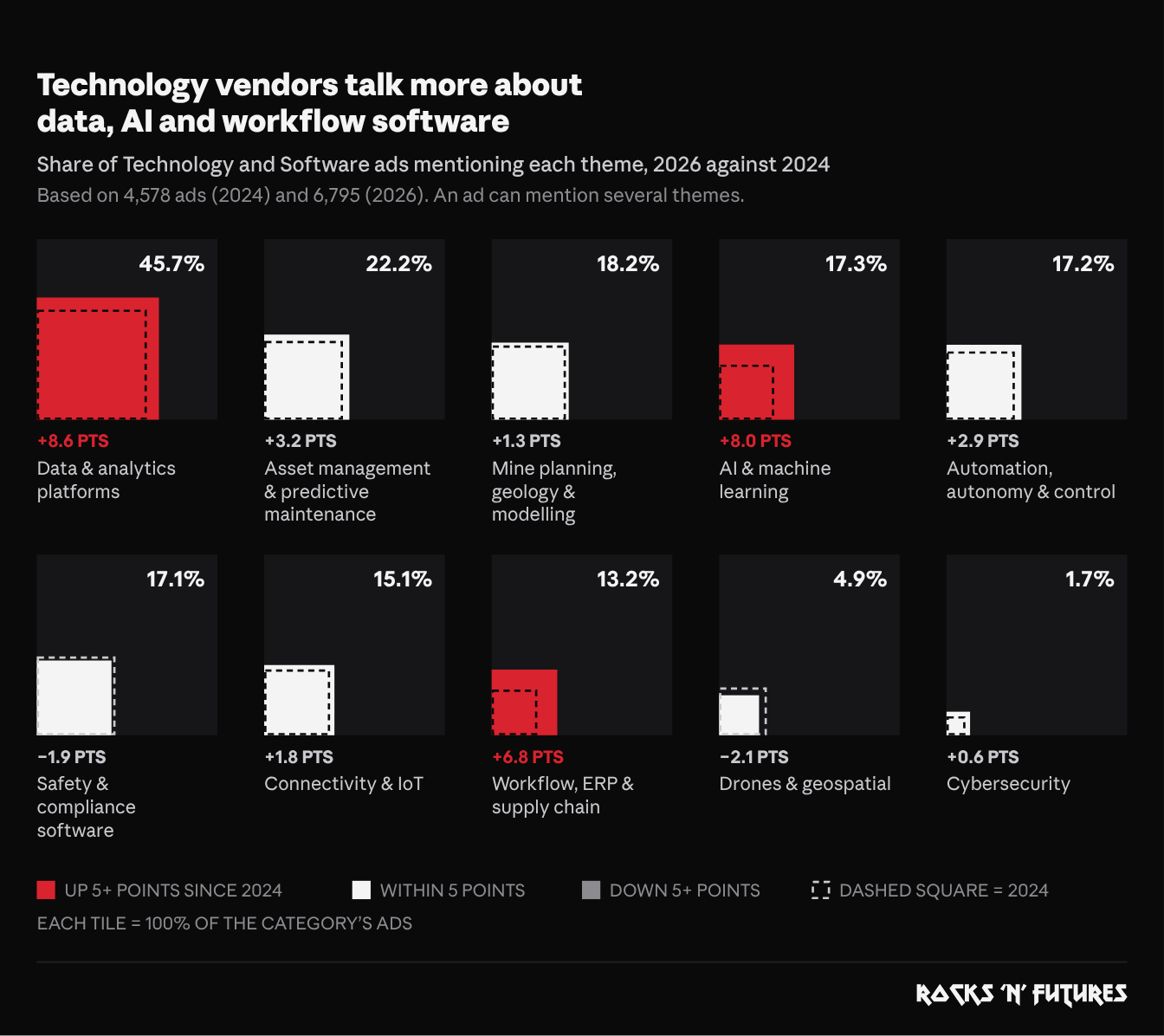
Mining software is consolidating into platforms.
So every point solution now needs a very good answer to the buyer's obvious question: why not just use the suite?
Equipment and machinery
Equipment makers lead with what keeps machines running, with service, parts and rebuilds in 32% of their ads, up from 24%, and FLS and Normet the most insistent.
Automation and autonomy more than doubled to 12% as Sandvik, Epiroc and Normet promoted automated drilling, tele-remote operation and autonomous machines.
Power and electrification slipped from 28% to 24%, and ventilation and dust messages lost share despite growing in number.
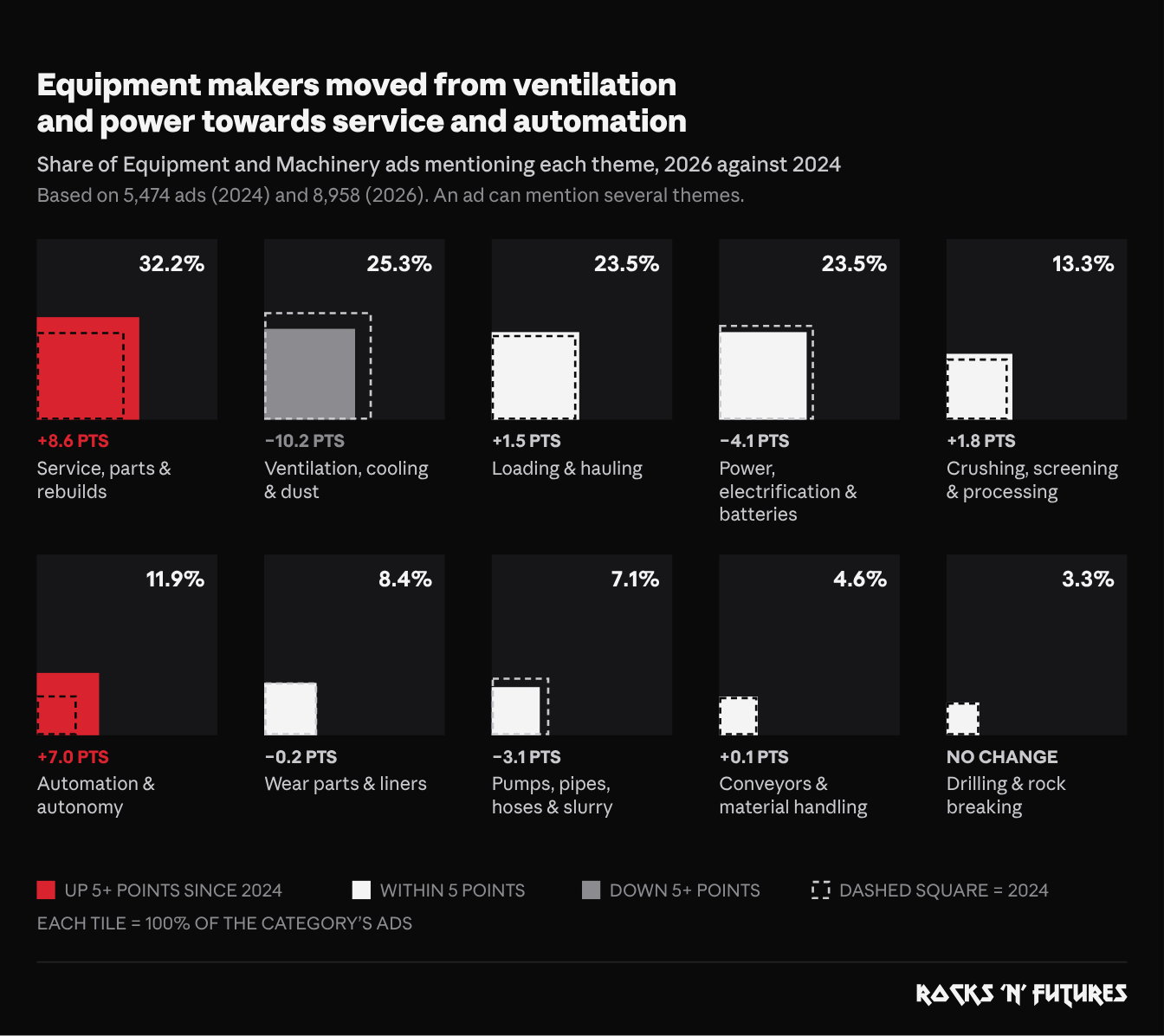
With buyers focused on cost and electrification slowing, manufacturers are selling more output from the fleet miners already own, and Epiroc's slogan puts it plainly: "Get more from the mine you already have."
Consulting and services
Risk, safety and compliance now lead consultants' pitches, in 36% of their ads against 27% in 2024, with EY, Cyient and dss+ to the fore.
Financial and tax advice almost doubled to 22% as Bain, EY and Deloitte promoted capital discipline, deals and tax work, and digital advisory rose to 26%, while operational improvement, sustainability advice and market insight all lost share.
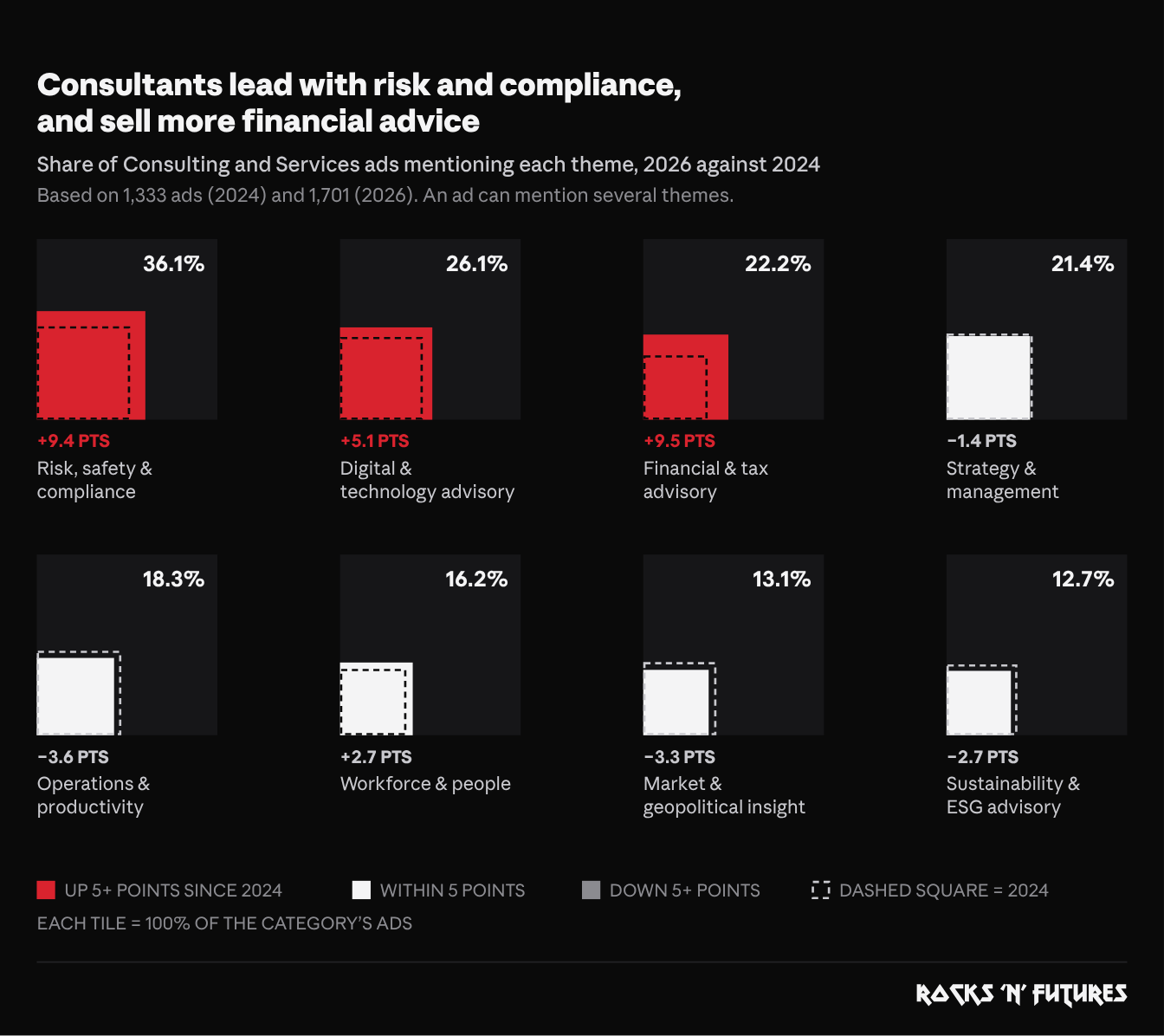
Consultants sell what boards worry about.
And right now boards are worrying about risk, capital and deals far more than transformation programmes.
Environmental
Dust, noise and air quality dominate, in 42% of environmental ads, largely because one firm, FlowCentric, ran a sustained dust-suppression campaign.
Water management and tailings gained share, while emissions and decarbonisation fell from 23% to 15%, the clearest retreat in the data.
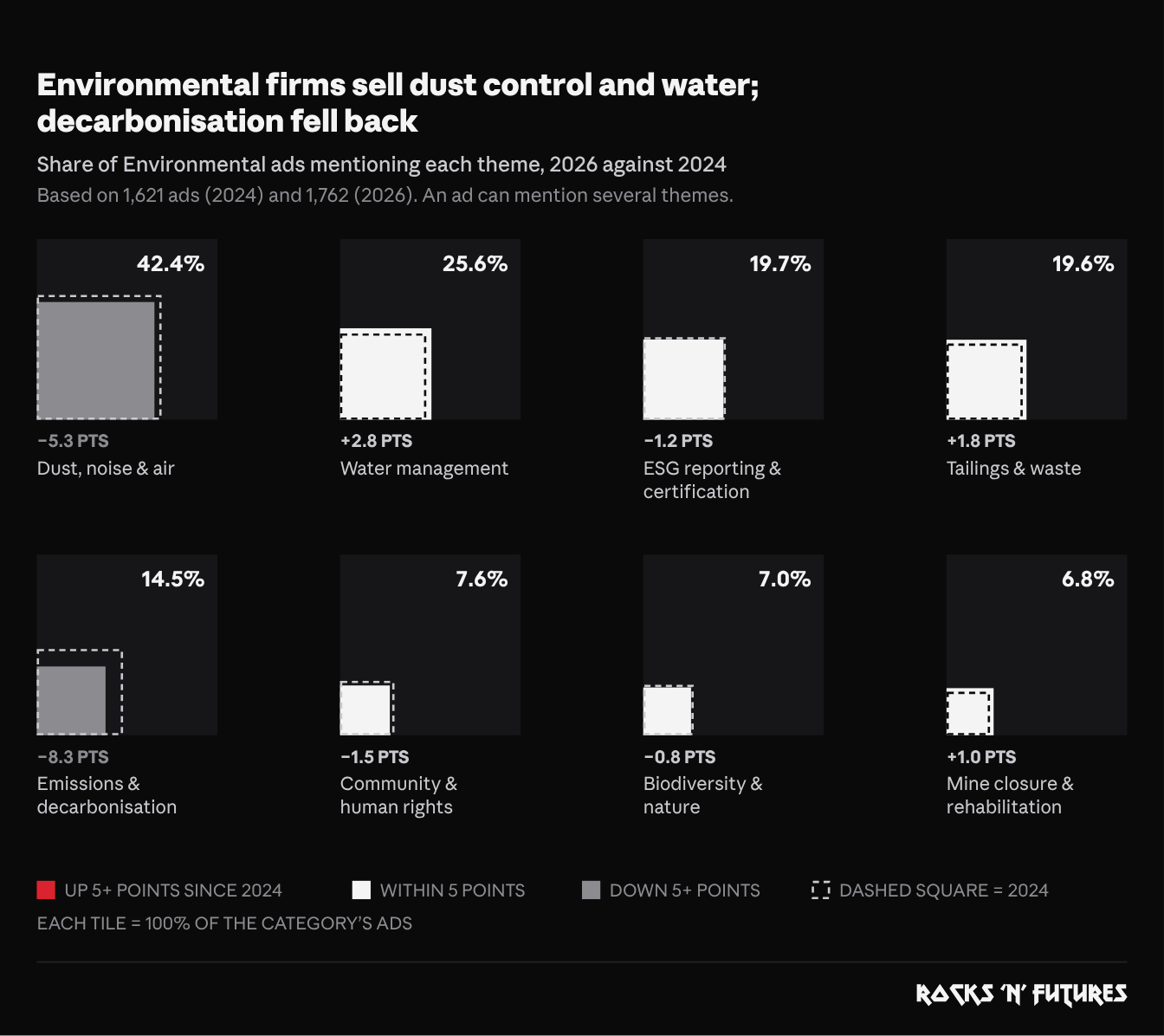
Environmental suppliers are moving from carbon to compliance.
And it makes sense when you think about it, because a problem that comes with a regulator, a fine or an angry neighbour is far easier to sell than a long-term target.
The rest of the industry
In investment and finance, paid promoters now push junior explorers to retail investors, with junior-miner promotion in 46% of finance ads and tutorials on investing in commodities in 17%, up from 8%, while banks and project financiers advertise less (18% of the category's ads, down from 26%).
With gold above $4,000 an ounce, the junior end of the market is courting individual investors directly, and it's worth remembering who carries the downside if the cycle turns.
Associations and events leaned hard into advocacy, which now features in 41% of their ads, up from 21%, led by the World Gold Council's gold campaign and the Minerals Council of Australia's "mining makes" messages, while standards and responsible mining fell from 20% to 7% and conferences and expos still fill half the category.
More mining companies advertise (130 against 96), and they spend more than most, with the typical mining company spending about $13,000 a year, among the highest of any group, and Glencore leading the way with its public case for coal and metals.
Government and NGOs doubled their share of ads to 2.4%, driven by provincial agencies such as Saskatchewan's and by campaigners, including Food Nature Climate Dialogue, which campaigns against the damage done by mining and farming and ran 408 ads, up from 13.
Safety and PPE vendors talk less about gas detection (10% of their ads, down from 21%) and more about protective clothing (23%, up from 18%) and safety software.
In training and education, short courses and certificates now fill 65% of ads, while degrees and executive education fell from 23% to 9%, so mining professionals are buying their skills in small pieces.
And media and market-intelligence firms such as Wood Mackenzie, Kpler and Fastmarkets lifted the category's share from 3.3% to 4.6%, selling metals outlooks and trade data to an industry preoccupied with prices and supply.
Read together, the categories describe an industry spending to justify itself, to raise money and to keep its existing machines running, far more than to transform how it works.
How mining sells on LinkedIn
The format of choice is still a single image with a "Learn more" button, but the edges are moving, and the most interesting movement has a person's face on it.
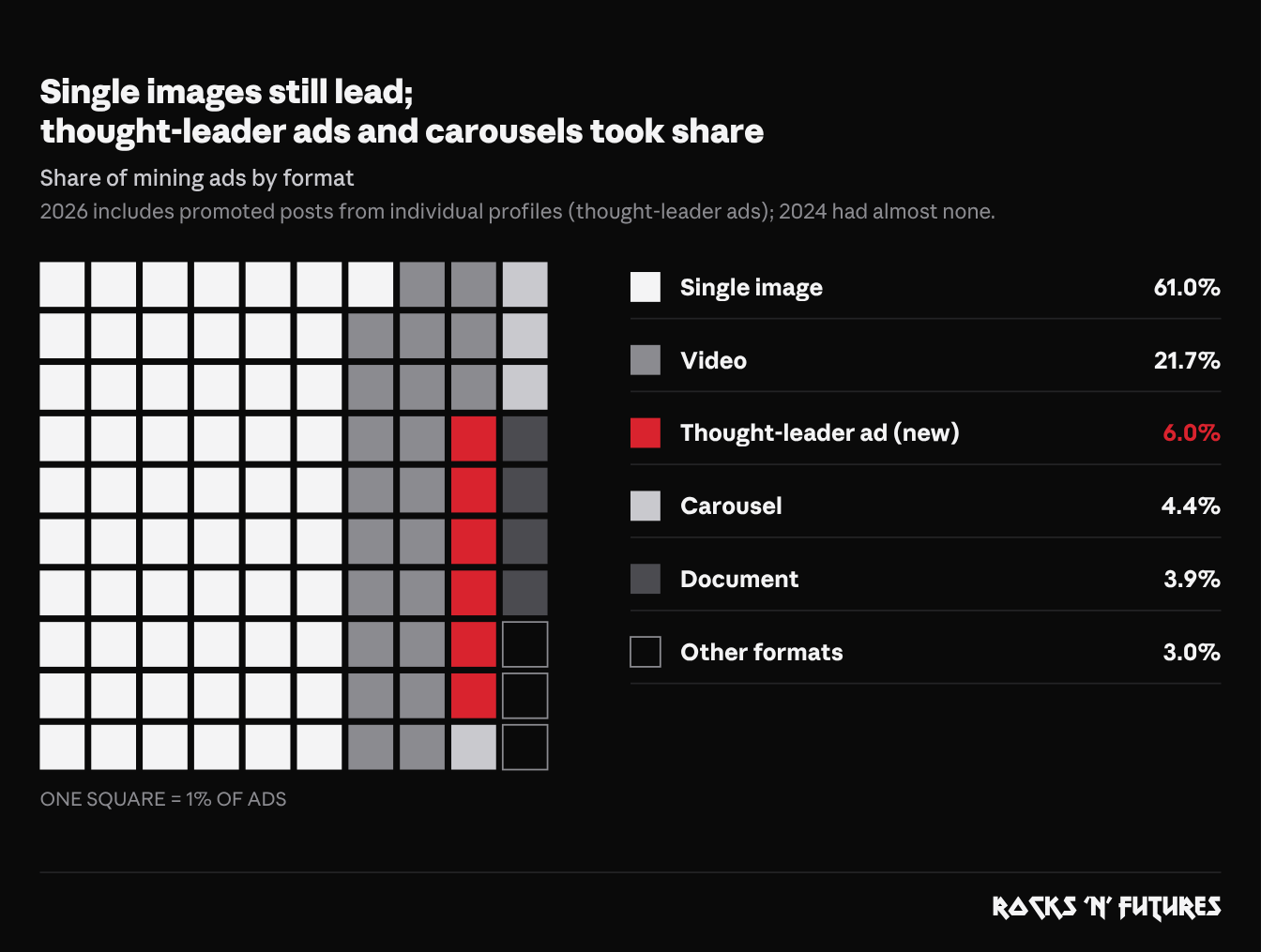
Single-image ads remain the default at 61% of the total, down from 69%, video holds steady at about a fifth, carousels rose from 3% to 4%, and article ads appeared for the first time.
The newcomer is the promoted post from a person's own profile, with 2,856 of them in 2026 against almost none in 2024.
More than a third of the people behind them are chief executives, founders or owners, and only 8% have a company paying for them.
In a market that buys on trust and track record, executives have started paying to be heard in their own name, and few companies have yet put money behind their own people's posts.
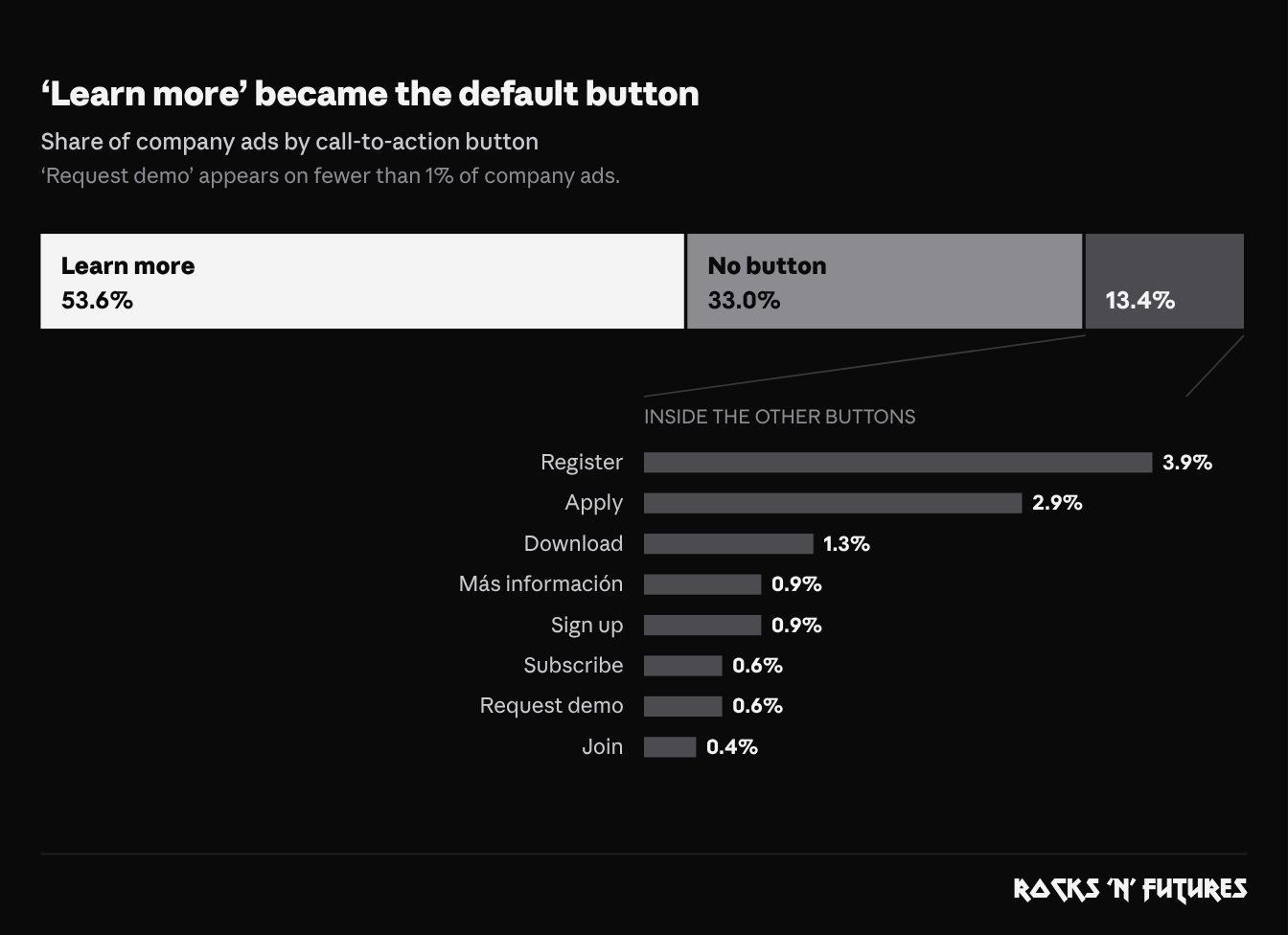
"Learn more" now appears on 54% of company ads, up from 44%, and ads with no button at all fell from 43% to 33%.
"Apply" nearly doubled, almost entirely because of AusIMM's courses, "Register" held level on webinars and Mining Indaba, and "Download" halved, a sign of fewer gated reports (I'm aware of the irony).
"Learn more" is the softest possible ask, the advertising equivalent of ending a first date with "we should catch up sometime".
Fewer than 1% of ads invite a demo.
That suits long sales cycles, but it leaves the direct ask almost unused.
Each category also runs to its own calendar.
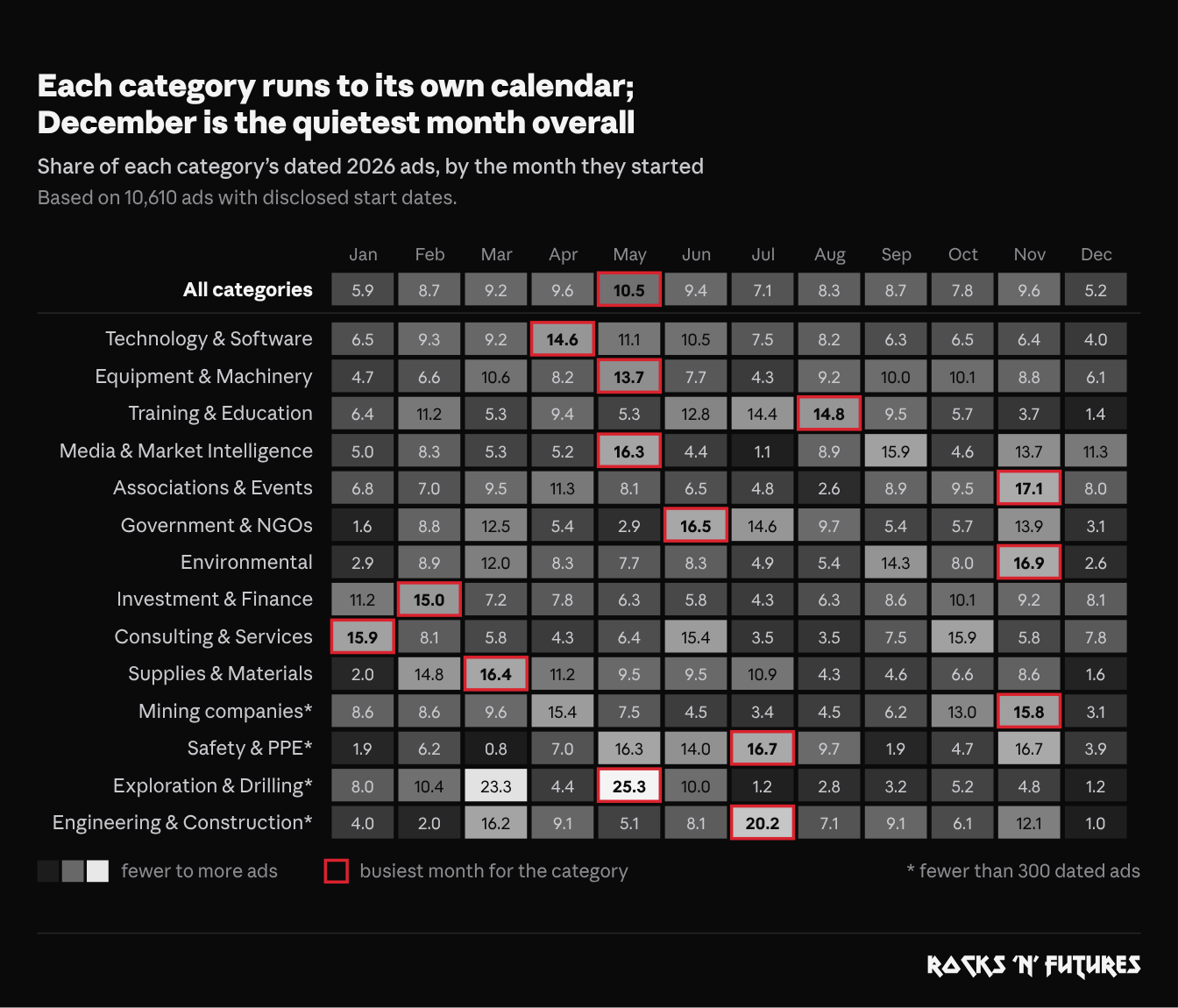
May is the busiest month for mining ads, and December and January are the quietest, at about half May's volume.
But counting advertisers rather than ads flattens the picture, with between 148 and 186 companies launching ads in every month from February to November, against 124 in December and 134 in January.
Single campaigns often set a category's peak, so FLS produced most of the equipment ads that started in May, and the World Gold Council most of the association ads that started in November.
Where many advertisers compete, the seasons are real, with technology peaking in April, finance in February, the month of Mining Indaba, and environmental firms in November, while July, the start of the European summer break, is weak for equipment, media and finance.
So December and January are the least crowded months for a mining brand on LinkedIn, and copying a category's busiest month often just means copying one company's campaign calendar.
Core message in LinkedIn advertising in 2026
Put simply, mining's advertising shows an industry whose priorities have quietly changed, with sustainability giving way to money, security and uptime, more spending on defending and financing itself, and AI still a story told mostly by the people selling software.
For suppliers, I'd take three things from it.
The bar to stand out is low, because most advertisers spend a few thousand dollars a year and stop after a handful of ads.
Persistence counts, because the advertisers that commit are the ones still there two years later.
And some of the industry's hardest problems have almost nobody advertising solutions to them.
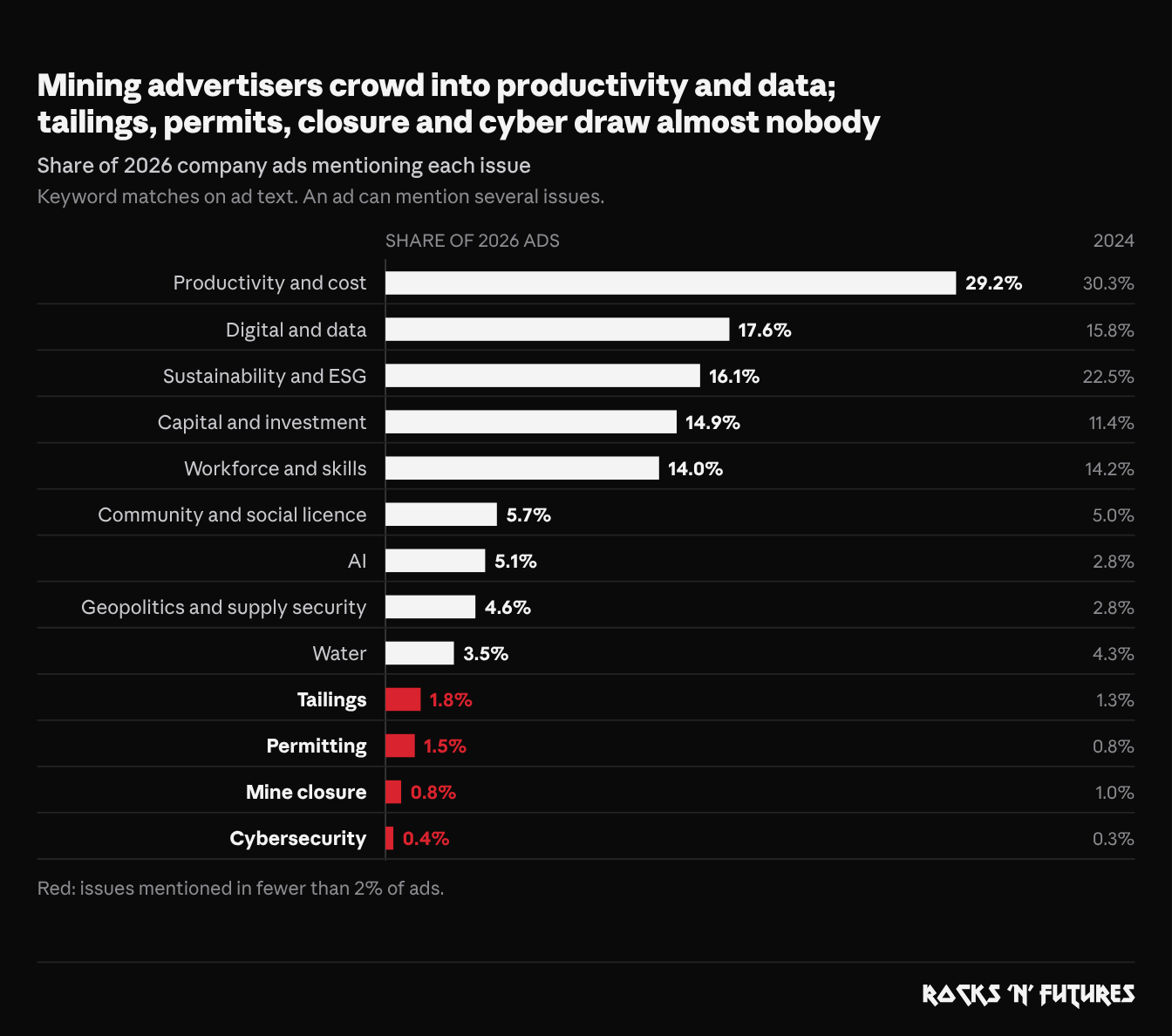
Tailings, permitting, mine closure and cybersecurity each appear in fewer than 2% of ads, even though tailings failures, permitting delays and closure liabilities shape the economics of every mine, and autonomous, remotely operated machines widen the openings for cyber attack.
These are the open lanes, and a supplier with a credible answer to any of them would face almost no competition for attention.
It's not rocket science.
It just means turning up more than once.
How this report was made
We searched LinkedIn's public Ad Library for the keyword "mining" and collected every result shown for 19 October 2025 to 18 October 2026, with full details for 35,501 ads.
The comparison comes from a November 2024 collection covering roughly the previous twelve months, rebuilt with the same rules, so some 2024 figures differ from the original 2024 article.
Both years went through the same filters, which removed ads that matched "mining" by accident (data mining, crypto mining, process mining and similar) and advertisers with no link to the industry.
Every advertiser carries one category, assigned mostly by hand, which left 38,275 company ads from 3,516 advertisers in 2026 and 23,302 ads from 3,380 advertisers in 2024, plus 2,856 promoted posts from personal profiles in 2026.
C3 AI, an American software company, ran 18,432 near-identical ads from 15 messages, a third of all company ads in 2026, and because including it would make technology and AI look far larger than the rest of the market suggests, all figures and charts exclude it.
A theme's share counts the ads whose text mentions it, using the same word lists for both years, and one ad can mention several themes.
LinkedIn shows impression ranges for about a quarter of ads, mostly those seen in the European Union, so we applied each advertiser's average impressions to all its ads and priced them at $30 per thousand impressions, which covers 957 advertisers.
Treat spend as a rough guide, because ads shown only in Australia, for example, report no impressions at all.
LinkedIn's library returned far more results in 2026 than in 2024, partly because of how it indexes ads, so the report compares shares and patterns rather than raw totals.
For the 28 largest advertisers, details come from a sample of 200 ads each, scaled up to their full count.
Return rates match advertisers by page name, so a renamed page counts as a departure.
Sources: Miningmx, citing Bloomberg, on BHP and Rio Tinto (May 2026); Morrison Foerster on the EU's Omnibus I reporting changes (December 2025); Fortune on the gold price (October 2026).